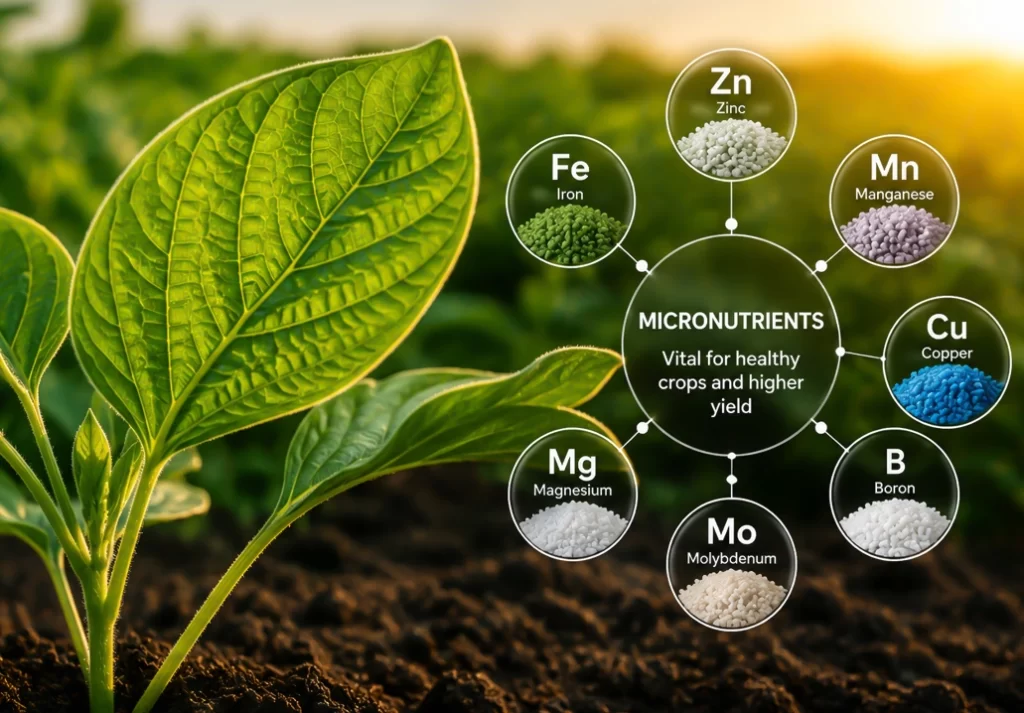
Modern agriculture is facing a growing challenge: producing more food from limited resources while maintaining soil health, crop quality, and sustainable productivity. While major nutrients such as Nitrogen, Phosphorus, and Potassium remain essential, micronutrients are becoming increasingly important for achieving balanced and efficient crop nutrition.
Micronutrients are required by plants in very small quantities, but their impact on crop growth, yield, quality, and overall plant health can be significant. In today’s intensive farming systems, proper micronutrient management is no longer an optional practice—it is an important part of modern crop nutrition.
What Are Micronutrients?
Micronutrients are essential elements that plants need in small amounts to complete important physiological and biochemical processes.
Key plant micronutrients include:
- Zinc (Zn) – Supports enzyme activity, growth, and hormone production.
- Iron (Fe) – Plays a vital role in chlorophyll formation and photosynthesis.
- Manganese (Mn) – Supports photosynthesis and various enzyme functions.
- Boron (B) – Important for cell development, flowering, and reproductive growth.
- Copper (Cu) – Contributes to enzyme activity and plant metabolism.
- Molybdenum (Mo) – Helps plants efficiently utilize nitrogen.
- Chlorine (Cl) – Supports water balance and photosynthetic processes.
- Nickel (Ni) – Involved in nitrogen metabolism and enzyme activity.
Although plants require these nutrients in relatively small quantities, a deficiency can significantly affect crop performance.
Why Are Micronutrients More Important Today?
Agricultural practices have changed considerably over the years. High-yielding crop varieties, intensive cultivation, repeated cropping, imbalanced fertilizer use, and declining soil organic matter can contribute to micronutrient deficiencies.
At the same time, farmers are expected to achieve higher productivity while using resources more efficiently.
This is where micronutrient management becomes increasingly valuable.
1. Intensive Cropping Removes More Nutrients
Modern high-yielding crops extract substantial quantities of nutrients from the soil. When the same land is cultivated repeatedly without adequate nutrient replenishment, certain micronutrients can gradually become deficient.
2. Soil Health Is Changing
Soil pH, organic matter, moisture, and other chemical and physical properties influence micronutrient availability. A nutrient may be present in the soil but unavailable to the plant in an absorbable form.
3. Balanced Nutrition Supports Better Crop Performance
Plants require a balanced supply of essential nutrients. Supplying only major nutrients may not be enough to achieve optimum crop development when micronutrients are limiting.
How Micronutrients Help Crops
Micronutrients participate in several critical plant processes, including:
Photosynthesis:
Elements such as iron and manganese contribute to processes associated with photosynthesis and energy production.
Enzyme Activity:
Zinc, copper, manganese, and other micronutrients support numerous enzyme-driven reactions within plants.
Flowering & Reproductive Growth:
Boron and other micronutrients play important roles in flowering, pollen development, and reproductive processes.
Root & Shoot Development:
Adequate micronutrient availability supports healthy vegetative growth and root development.
Nutrient Utilization:
Micronutrients can contribute to efficient metabolic processes, helping plants make effective use of available nutrients.
Recognizing Micronutrient Deficiency
Micronutrient deficiencies can appear differently depending on the crop, soil conditions, and nutrient involved.
Common symptoms may include:
- Yellowing or chlorosis of leaves
- Reduced plant growth
- Smaller leaves
- Poor flowering or fruit development
- Weak plant structure
- Reduced root development
- Uneven crop growth
- Lower yield and quality
However, visual symptoms alone should not always be used to identify a deficiency. Soil and plant analysis can provide a more reliable basis for nutrient management.
Micronutrients and the Future of Sustainable Agriculture
The goal of modern agriculture is not simply to apply more fertilizer—it is to use the right nutrients, in the right amount, at the right time and through the right method.
Micronutrient management can become an important part of this approach.
By understanding soil conditions, crop requirements, and nutrient availability, farmers can develop more precise nutrition programs. Foliar applications, soil applications, and other nutrient-delivery methods may be used depending on the crop and deficiency situation.
The Role of Technology in Micronutrient Management
Agricultural technology is making nutrient management more precise than ever.
Modern approaches can combine:
- Soil testing
- Plant tissue analysis
- Crop-stage monitoring
- Precision agriculture
- Improved nutrient formulations
- Targeted application methods
- Data-driven crop nutrition programs
These approaches can help farmers move from generalized fertilizer application toward crop-specific and field-specific nutrient management.
Micronutrients: Small Requirement, Significant Role
The importance of micronutrients lies in a simple principle: small quantities can have a significant biological impact.
A crop may require micronutrients in grams or kilograms rather than hundreds of kilograms, but deficiency of even one essential element can interfere with important physiological processes.
Therefore, micronutrients should not be viewed as secondary simply because plants require them in smaller quantities.
They are an essential part of balanced plant nutrition.
A Smarter Approach to Crop Nutrition
Today’s agriculture demands efficiency, productivity, and sustainability. Farmers need nutrition strategies that support crop performance while making responsible use of soil and other resources.
A well-planned micronutrient management program can help address specific nutritional requirements and complement the role of primary and secondary nutrients.
The future of agriculture is moving toward precision, balance, and efficiency—and micronutrients are an important part of that journey.
Conclusion
Micronutrients may be needed in small amounts, but their role in plant growth and development is far from small. As intensive agriculture continues to evolve, maintaining balanced crop nutrition will become increasingly important.
Micronutrients are not simply an additional input—they are a vital component of modern crop nutrition.
With better soil understanding, scientific crop nutrition, and precise nutrient management, farmers can move toward healthier crops, improved productivity, and more sustainable agricultural practices.
In today’s agriculture, micronutrients are a small investment with a potentially significant role in building the future of farming.