Modern agriculture is evolving rapidly. With increasing pressure on farmers to improve crop productivity, quality, and resilience while using resources more efficiently, traditional crop nutrition alone may not always be enough.
This is where biostimulants are gaining importance.
Biostimulants are becoming an integral part of modern crop management because they can support natural plant processes, improve crop performance under challenging conditions, and complement conventional fertilizers and other agricultural inputs.
What Are Biostimulants?
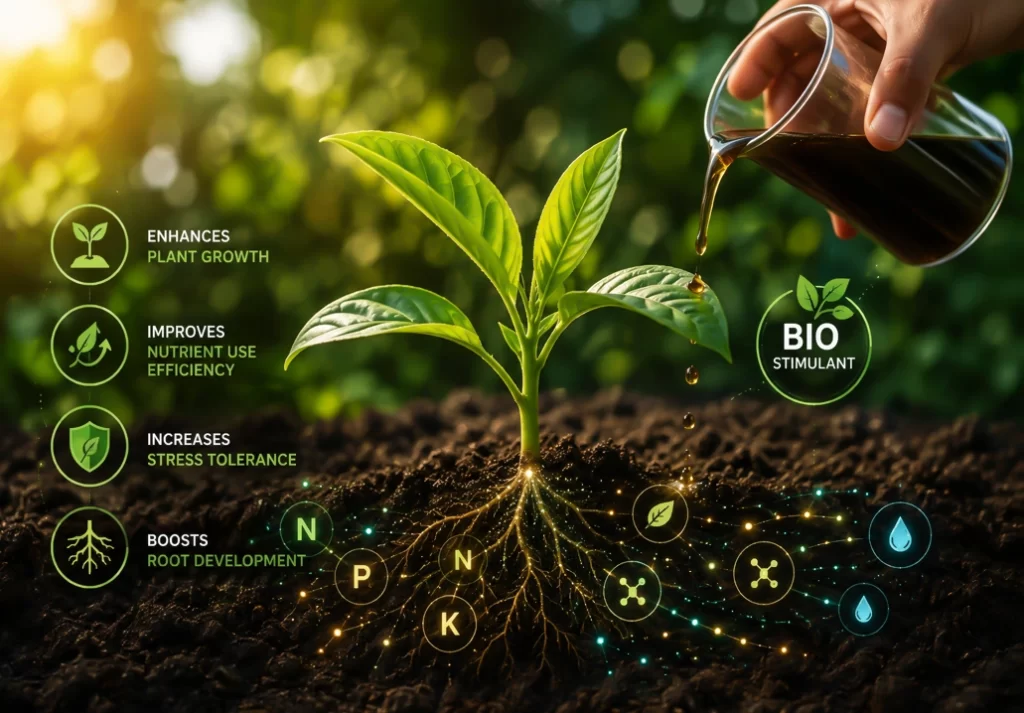
Biostimulants are substances or microorganisms used to stimulate natural processes in plants or the plant’s surrounding environment.
Unlike conventional fertilizers, which primarily provide nutrients, biostimulants are generally designed to support plant physiological processes and improve the plant’s ability to use nutrients, tolerate environmental stress, and maintain healthy growth.
Depending on their composition and intended use, biostimulants may include:
- Seaweed and algae-based extracts
- Humic and fulvic substances
- Amino acids and peptides
- Beneficial microorganisms
- Plant-based extracts
- Certain organic compounds
- Microbial-based formulations
The exact benefits depend on the type of biostimulant, crop, application method, environmental conditions, and formulation.
Why Are Biostimulants Important Today?
Agriculture is increasingly exposed to environmental and production challenges such as:
- Water scarcity
- Temperature fluctuations
- Salinity
- Soil degradation
- Nutrient-use inefficiency
- Increasing crop production costs
- Changing climatic conditions
These challenges can place significant stress on crops.
Biostimulants are being explored and adopted as part of integrated crop-management strategies to help plants perform more efficiently under varying growing conditions.
How Do Biostimulants Work?
Biostimulants do not simply act as a source of nutrients. Their purpose is to influence natural plant processes.
Depending on the formulation, they may support:
1. Root Development
Healthy roots are fundamental to crop performance. Certain biostimulants can support root growth and development, helping plants establish stronger root systems.
A well-developed root system can improve the plant’s ability to access water and nutrients from the growing environment.
2. Nutrient-Use Efficiency
Biostimulants can complement fertilizer programs by supporting physiological processes involved in nutrient uptake and utilization.
This can contribute to more efficient crop nutrition when combined with appropriate soil and fertilizer management.
3. Plant Growth and Development
Certain biostimulant formulations may support processes associated with plant growth, development, flowering, fruit development, and overall crop performance.
Their role is generally complementary rather than a replacement for essential plant nutrients.
4. Stress Management
Plants can experience different forms of abiotic stress, including heat, drought, salinity, and unfavorable environmental conditions.
Some biostimulants are used to support natural plant responses to these stresses and help crops maintain physiological activity during challenging conditions.
5. Crop Quality
Crop quality is becoming increasingly important alongside yield.
Depending on the crop and formulation, biostimulant applications may contribute to improved crop characteristics and more uniform plant development.
Major Types of Biostimulants
Biostimulants can come from several different sources.
Seaweed & Algae Extracts
Seaweed-based products contain naturally occurring compounds and are widely used in crop-management programs.
They are commonly applied to support plant growth, development, and stress-management strategies.
Humic & Fulvic Substances
Humic and fulvic substances are associated with soil and plant nutrient management. They may support soil properties and nutrient availability when incorporated into a broader crop nutrition program.
Amino Acids & Peptides
Amino acids are important building blocks of proteins and participate in numerous plant metabolic processes.
Amino-acid-based biostimulants are commonly used as part of crop nutrition and stress-management programs.
Beneficial Microorganisms
Certain microorganisms can interact with plants and the soil environment.
Microbial biostimulants may support nutrient cycling, root-zone activity, and plant–microbe interactions.
Biostimulants vs. Fertilizers
It is important to understand that biostimulants and fertilizers serve different primary purposes.
| Fertilizers | Biostimulants |
|---|---|
| Primarily provide essential nutrients | Support natural plant processes |
| Supply nutrients such as N, P, K and micronutrients | May improve nutrient-use efficiency and plant responses |
| Address nutritional requirements | Complement crop nutrition and stress-management programs |
| Form an important part of plant nutrition | Form an additional tool within integrated crop management |
Biostimulants should therefore generally be viewed as a complement to balanced crop nutrition, rather than a direct replacement for fertilizers.
When Can Biostimulants Be Used?
The appropriate application stage depends on the crop and product formulation.
Biostimulants may be incorporated into crop-management programs during stages such as:
- Seed treatment
- Early vegetative growth
- Root establishment
- Pre-flowering
- Flowering
- Fruit development
- Periods of environmental stress
- Recovery after stressful conditions
Application should always follow the product label and recommended dosage.
The Role of Biostimulants in Sustainable Agriculture
Sustainable agriculture requires more than simply increasing crop yields. It also requires better management of soil, water, nutrients, and other agricultural resources.
Biostimulants can contribute to this approach by supporting:
Efficient Crop Management
They can complement conventional nutrition and crop-protection programs.
Better Resource Utilization
Some biostimulants are studied for their potential to improve nutrient- and water-use efficiency.
Crop Resilience
Certain formulations may help crops manage environmental stresses.
Soil and Root-Zone Health
Microbial and organic-based products can play a role in maintaining a productive root environment.
Biostimulants and the Future of Agriculture
The future of agriculture is moving toward precision, efficiency, sustainability, and biological solutions.
As farmers gain access to better crop data, improved formulations, soil testing, precision agriculture, and advanced application technologies, biostimulants can become an increasingly valuable component of integrated crop-management programs.
However, successful use requires understanding the specific crop, soil conditions, climate, product formulation, application timing, and recommended dosage.
There is no single biostimulant solution suitable for every crop or every field.
Choosing the Right Biostimulant
Before using a biostimulant, farmers should consider:
- Crop and variety
- Soil characteristics
- Environmental conditions
- Crop growth stage
- Existing fertilizer program
- Specific production objective
- Product composition
- Application method
- Recommended dosage
A science-based approach can help maximize the value of biostimulant applications.
Conclusion
Biostimulants represent an important development in modern agriculture.
They are not simply another source of plant nutrients. Instead, they are designed to support natural plant processes, complement crop nutrition, improve plant performance, and contribute to more efficient crop-management strategies.
As agriculture continues to face climate variability, resource constraints, and increasing productivity demands, biostimulants can become an important tool in building resilient and sustainable farming systems.
The future of agriculture is not only about feeding the plant—it is about supporting the plant’s natural ability to grow, adapt, and perform.
Biostimulants are helping take crop management in that direction.